
CryptoCasino.cc originals put verification at the center of play
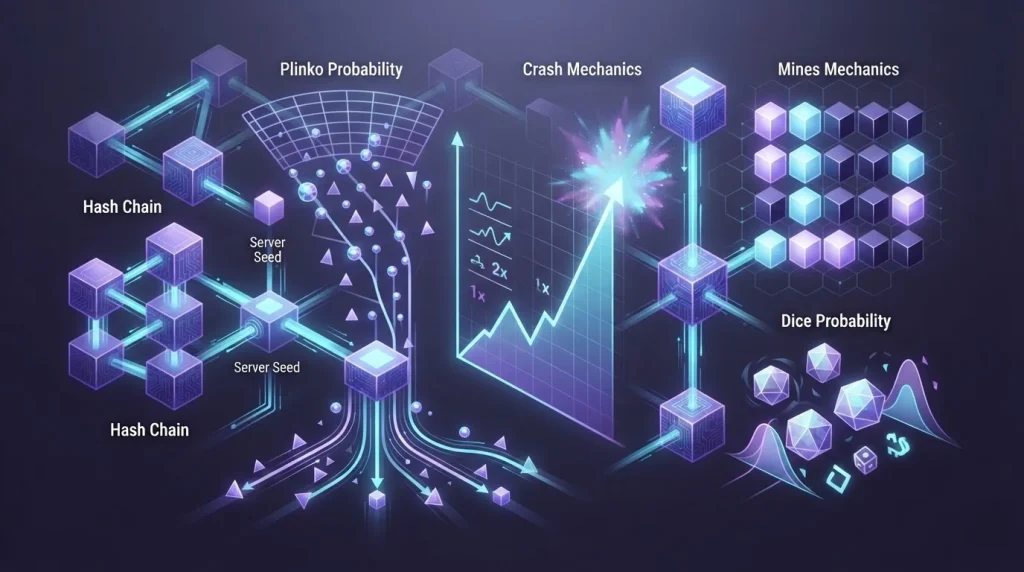
Table of Contents
- Six originals cover several different risk shapes
- Provably fair checks the round, not the value proposition
- A verification habit is more useful than trusting a badge
- Hash verification leaves three major questions unanswered
- Live tables and originals solve different trust problems
- Fast originals make session control part of the mechanics
- Questions about CryptoCasino.cc originals
- Use verification as evidence, not a promise
Section element
Game mechanics and verification
CryptoCasino.cc lists six crypto originals—Crash, Plinko, Limbo, Mines, Dice and Keno. The useful question is not simply whether these games are labeled provably fair, but what a player can actually verify and what remains outside that check.
Section element
- Originals listedCrash, Plinko, Limbo, Mines, Dice, Keno
- Fairness positioningProvably fair
Six originals cover several different risk shapes
CryptoCasino.cc lists Crash, Plinko, Limbo, Mines, Dice and Keno among its originals. They share a crypto-native presentation, but they do not behave the same way. Crash and Limbo usually revolve around a multiplier or target threshold; Dice typically centers on a numerical probability choice; Mines adds sequential reveal risk; Plinko distributes outcomes across a board; Keno is a number-selection game.
Crash and Limbo
These games are easy to understand visually because the trade-off between a higher target and a lower hit rate is immediate. A short winning streak can still sit inside a negative long-run expectation.
Mines
Each additional reveal changes the round state. A player deciding whether to continue is managing exposure inside a single round rather than simply repeating one fixed bet.
Dice
Dice makes probability especially visible. That transparency is useful for understanding variance, but it does not remove the house edge.
Plinko and Keno
These formats can produce highly dispersed outcomes. The visual simplicity can obscure how quickly variance accumulates over many rounds.
The broader CryptoCasino.cc games guide places these titles beside slots and live tables, while the live casino section explains how streamed dealer games differ operationally.
Provably fair checks the round, not the value proposition
A provably-fair system generally lets the player compare cryptographic inputs used to produce an outcome. The typical pattern combines a server-side secret, a player-side seed or nonce, and a hash commitment. The important idea is sequence: the casino commits to information before the round, the round is resolved, and the player can later check whether the disclosed values reproduce the same result.
- Commitment
- A cryptographic hash can lock in a hidden server value before the outcome is known to the player.
- Player input
- A client seed or nonce can add a value that is not solely controlled by the operator.
- Reveal
- After play, the server value can be disclosed and compared against the earlier commitment.
- Recalculation
- A verifier can recompute the outcome from the same inputs and check whether the result matches.
A verification habit is more useful than trusting a badge
The practical benefit appears only if the player can follow the evidence chain. A label on a game tile is not the same thing as verifying a round. The sequence below is the part worth learning.
- Before or during play, locate the fairness panel and identify the client seed, server-hash commitment or round identifier exposed by the game.
- Record the relevant values for a test round. Copying them exactly matters because one changed character produces a different hash.
- After the round, obtain the disclosed server seed or equivalent value and open the built-in verification flow if one is provided.
- Recalculate the round using the same seed, nonce and algorithm description. The reproduced result should match the displayed outcome.
- Repeat the check on more than one round. A repeatable process is more informative than a single successful example.
Provably-fair verification does not provide a return percentage for Crash, Plinko, Limbo, Mines, Dice or Keno. RTP and house edge require separate game mathematics or audited return data. That distinction matters when comparing the originals with broader payment constraints: transaction rules and game fairness answer different questions.
Hash verification leaves three major questions unanswered
What it can demonstrate
- The round can be recalculated from disclosed inputs.
- The committed value matches the later reveal.
- The displayed result follows the stated deterministic process.
What still needs separate scrutiny
- RTP or house edge for the specific title.
- Volatility and the distribution of rare outcomes.
- Whether the implementation or verifier itself has been independently audited.
| Question | Provably fair helps? | Why |
|---|---|---|
| Was this round changed after commitment? | Yes | Hashes and revealed seeds can expose a mismatch. |
| What is the long-run RTP? | No | RTP requires game mathematics or audited return data. |
| How volatile is the game? | No | Variance depends on the payout distribution across many outcomes. |
| Will a withdrawal be processed quickly? | No | Cashout operations belong to the payment system, not the fairness algorithm. |
Live tables and originals solve different trust problems
CryptoCasino.cc also offers live blackjack, roulette, baccarat, poker, game shows and lightning-style titles through named live providers. Those games are streamed from dealer studios, so the player is observing a physical or presenter-led process rather than reconstructing a purely digital round from seeds.
That difference changes the type of evidence that matters. For an original, the key question is whether the algorithmic result can be reproduced. For a live table, practical checks include the provider name, published table rules, visible betting limits and connection quality. Neither format should be treated as inherently safer simply because one is cryptographic and the other is streamed.
The live casino guide goes deeper into streamed-table latency and provider roles, while the main games page maps all major categories together.
Fast originals make session control part of the mechanics
Originals are often built for rapid repetition. That speed can make the experience feel simpler than slots or live tables, but it also compresses decision time. When rounds resolve quickly, a player can move through many wagers before noticing how much total exposure has accumulated. The practical countermeasure is to decide the session boundary before the first round rather than after a streak has already changed the bankroll.
Use a fixed session amount
Separate the amount reserved for the session from the rest of the wallet. A fixed ceiling turns a vague intention to “stop soon” into a concrete boundary.
Track rounds as well as money
Rapid games can hide repetition. Counting rounds or using a time limit makes the pace visible even when individual bets are small.
Do not chase verification results
A successful fairness check only shows that a round followed the committed process. It is not a signal that the next round is more likely to win.
Variance also changes how short sessions feel. A cluster of losses can happen even when a game behaves exactly as designed, and a cluster of wins can create the opposite illusion. Neither sequence proves that the underlying probability has shifted. This is why provably-fair verification works best as an integrity check, while bankroll and time limits handle behavioral risk.
Questions about CryptoCasino.cc originals
Which CryptoCasino.cc originals are listed?
Crash, Plinko, Limbo, Mines, Dice and Keno are listed among the casino’s crypto originals.
Are the originals described as provably fair?
The originals are presented with provably-fair positioning. Provably fair verifies round construction; it does not establish RTP or house edge by itself.
Does provably fair mean a game has a high RTP?
No. Provably fair is about verifying how an outcome was produced; it does not establish RTP, house edge or low variance by itself.
What should I record before checking a round?
Keep the relevant seed, hash or round details shown by the game interface before or after play so the result can be compared with the verifier flow.
Are live casino games the same as originals?
No. Live casino games use streamed tables and dealers, while originals such as Crash or Plinko are digital games with different mechanics.
Use verification as evidence, not a promise
CryptoCasino.cc gives its originals a clear crypto-native identity through Crash, Plinko, Limbo, Mines, Dice and Keno. The strongest way to use provably-fair mechanics is to reproduce individual outcomes and keep that result separate from questions about RTP, variance and bankroll exposure. A verifiable round can be fair in construction and still be expensive over repeated play.